2026-05-25 by UDIAG
Introduction
Modern vehicles generate an enormous amount of electronic data every time they are driven. From engine performance and fuel efficiency to emissions monitoring and transmission behavior, nearly every major vehicle system now communicates through onboard electronics. This is why the OBD2 scanner has become one of the most essential tools in modern automotive diagnostics.
However, many drivers and even some technicians misunderstand what an OBD2 diagnostic tool can actually do. Some believe it can instantly identify every problem in a vehicle, while others assume all scanners provide the same level of diagnostic capability. In reality, the effectiveness of an OBD2 scanner depends heavily on its software depth, communication stability, and system access.
Understanding what an OBD2 scanner can truly read—and where its limitations begin—is critical for anyone involved in vehicle maintenance or diagnostics.
Why OBD2 Scanners Became Essential
The OBD2 system became mandatory in many markets after the mid-1990s as emissions regulations and electronic vehicle systems evolved. Originally designed to monitor emissions-related faults, the OBD2 interface gradually became the standard gateway for vehicle diagnostics.
Today’s vehicles may contain more than 100 electronic control units (ECUs), managing everything from fuel injection and transmission shifting to braking systems and advanced driver assistance technologies. Without an OBD2-based communication system, diagnosing modern vehicles would be significantly more difficult and time-consuming.
As automotive systems became increasingly software-driven, workshops also shifted from purely mechanical troubleshooting to data-based diagnostics. An OBD2 scanner is no longer simply a “code reader”; it has become the starting point for analyzing how a vehicle behaves in real operating conditions.
Different Types of OBD2 Scanners and Their Main Functions
Not all OBD2 scanners are designed for the same users or diagnostic depth. The market now includes everything from basic code readers to advanced professional diagnostic platforms.
Basic OBD2 code readers are primarily designed to retrieve and clear engine-related fault codes. These entry-level tools are commonly used by vehicle owners who want to identify the cause of a check engine light. While affordable and simple to use, they often provide limited access to live data and cannot communicate with many non-engine systems.
Mid-level OBD2 scanners expand diagnostic capability by adding functions such as live data streams, service resets, and limited system diagnostics. These tools are often used by independent workshops and experienced DIY users because they offer a balance between functionality and affordability.
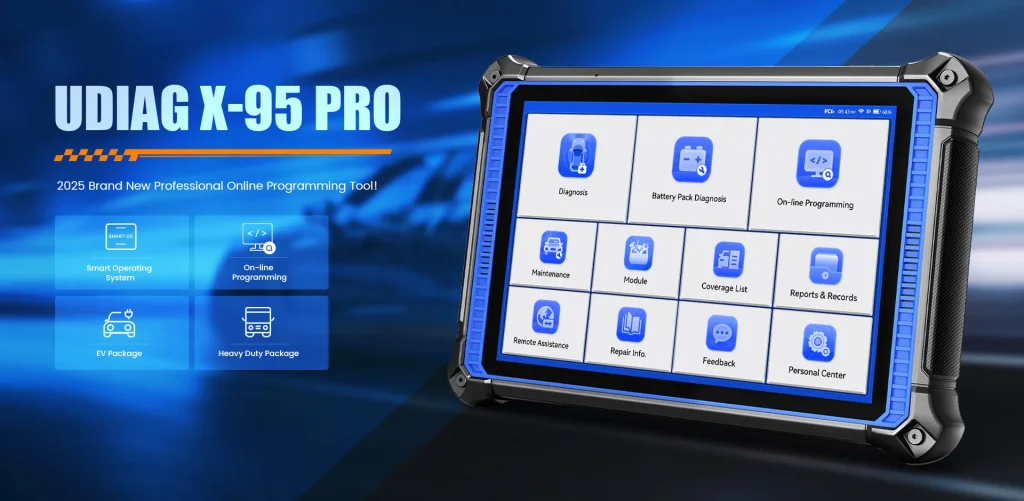
Professional diagnostic scanners go far beyond standard OBD2 functionality. They support full-system diagnostics, bidirectional control, ECU coding, and advanced service procedures. Modern professional platforms, such as the UDIAG X-95 PRO professional diagnostic tablet, are designed to diagnose complex vehicle systems while maintaining stable communication across multiple brands and protocols.
Wireless Bluetooth OBD2 scanners have also become increasingly popular. These compact devices connect to smartphones or tablets and are typically used for quick vehicle health checks or basic diagnostics. While convenient, their capabilities are usually limited compared to professional workshop equipment.
What an OBD2 Scanner Can Really Read
One of the biggest misconceptions about OBD2 scanners is that they only read fault codes. In reality, modern scanners can access a wide range of vehicle information depending on their software capability and system coverage.
An OBD2 scanner can retrieve diagnostic trouble codes (DTCs), monitor live sensor data, display freeze-frame information, and check emissions readiness status. These functions provide valuable insight into how the engine and related systems are operating under real driving conditions.
Live data analysis has become especially important in modern diagnostics. Instead of relying solely on stored fault codes, technicians can observe fuel trim values, oxygen sensor behavior, engine load, coolant temperature, and airflow readings in real time. This allows workshops to identify intermittent problems that may not immediately trigger warning lights.
More advanced diagnostic platforms can also access manufacturer-specific systems such as ABS, airbag modules, transmission systems, and electronic parking brake controls. This deeper access is one of the major differences between generic OBD2 scanners and professional automotive diagnostic tools.
Why Some Problems Cannot Be Detected by Basic OBD2 Scanners
Many vehicle owners become frustrated when a warning light appears but their scanner shows no fault codes. In most cases, this is not because the problem does not exist—it is because the scanner lacks sufficient system access.
Basic OBD2 scanners primarily focus on generic engine and emissions-related codes. However, modern vehicles contain many systems that operate outside generic OBD2 standards. Problems related to ABS, airbags, body electronics, ADAS systems, and transmission modules often require manufacturer-level communication protocols.
Software limitations are another major factor. Two scanners may connect to the same vehicle but retrieve different information because their databases and decoding capabilities differ significantly. This is why professional workshops prioritize software quality and update frequency rather than relying only on hardware specifications.
Vehicle communication architecture is also evolving rapidly. Technologies such as CAN FD, secure gateways, and over-the-air updates are changing how diagnostic tools interact with vehicles. Older or entry-level OBD2 scanners may struggle to communicate reliably with these newer systems.
How to Use an OBD2 Scanner Correctly
Using an OBD2 scanner effectively requires more than simply plugging it into the vehicle and reading codes. Accurate diagnostics depend on understanding how vehicle conditions affect data interpretation.
Battery voltage, ignition status, and communication stability all influence diagnostic results. Low voltage conditions, for example, may cause modules to behave unpredictably and generate misleading fault codes. Clearing codes without analyzing freeze-frame data can also make intermittent problems more difficult to identify later.
Professional technicians typically combine fault code analysis with live data monitoring and active testing procedures. Rather than replacing parts immediately after reading a code, experienced diagnosticians analyze sensor behavior and system response before confirming the root cause.
This diagnostic workflow is one reason why advanced workshops achieve higher accuracy and avoid unnecessary component replacement.
The Difference Between Generic OBD2 and Professional Diagnostics
Although many scanners advertise “full vehicle coverage,” the actual diagnostic depth can vary dramatically between entry-level tools and professional platforms.
Generic OBD2 vs Professional Diagnostic Tools
| Feature | Basic OBD2 Scanner | Professional Diagnostic Tool |
|---|---|---|
| Engine Fault Codes | Yes | Yes |
| Live Data | Basic | Advanced Real-Time Analysis |
| ABS / Airbag Access | Limited | Full-System Access |
| ECU Coding | No | Yes |
| Bidirectional Control | No | Yes |
| Service Functions | Basic | Advanced Multi-System Functions |
| Software Updates | Limited | Frequent Vehicle Coverage Updates |
Professional diagnostic platforms are designed not only to read information but also to interact with vehicle systems in deeper ways. This becomes increasingly important as vehicles rely more heavily on software, electronic modules, and network communication.
How Modern Workshops Use OBD2 Data More Efficiently
Modern workshops no longer treat OBD2 diagnostics as a simple code-reading process. Instead, diagnostic data is used as part of a broader repair strategy focused on accuracy and efficiency.
Live data streams help technicians compare sensor values under different operating conditions, making it easier to identify abnormal behavior before major failures occur. Freeze-frame data allows workshops to analyze the exact operating conditions present when a fault was triggered, which is particularly useful for intermittent issues.
Advanced diagnostic platforms also allow technicians to perform active tests and verify repairs more efficiently. By combining OBD2 data with bidirectional control and system-level diagnostics, workshops can reduce diagnostic time while improving repair confidence.
This data-driven approach has become essential as modern vehicles continue to integrate more electronic systems and software-based functions.
Choosing the Right OBD2 Scanner in 2026
Choosing the right OBD2 diagnostic scanner is no longer simply about reading fault codes. Modern workshops and technicians must evaluate software capability, system coverage, communication stability, and long-term update support.
A scanner that performs well today but lacks future software support may quickly become outdated as vehicle technology evolves. This is especially important with the growing adoption of EV systems, secure gateways, and advanced driver assistance technologies.
Professional diagnostic platforms such as the UDIAG X-95 PRO are designed to address these challenges by combining full-system diagnostics, stable communication, live data analysis, and advanced service functionality in a single platform.
For workshops looking to improve diagnostic efficiency and support a wider range of vehicles, investing in a capable and regularly updated diagnostic system is becoming increasingly important.
Conclusion
An OBD2 scanner can provide far more information than simply reading a check engine light. Modern diagnostic tools can analyze live data, monitor vehicle systems, and help technicians identify increasingly complex problems.
However, not all OBD2 scanners offer the same level of capability. As modern vehicles become more software-driven, the difference between basic code readers and professional diagnostic platforms continues to grow.
Understanding these differences is essential for choosing the right tool, improving diagnostic accuracy, and keeping pace with the future of automotive repair.
FAQ
1. What does an OBD2 scanner actually do?
An OBD2 scanner communicates with a vehicle’s onboard computer systems to read diagnostic trouble codes (DTCs), monitor live data, and identify potential faults. Modern scanners can also access service functions, emissions data, and advanced electronic systems depending on the tool’s capability.
2. Can an OBD2 scanner diagnose all vehicle problems?
Basic OBD2 scanners mainly focus on engine and emissions-related systems. More advanced issues involving ABS, airbags, transmission modules, ADAS, or EV systems often require professional diagnostic tools with full-system access.
3. What is the difference between a code reader and a professional diagnostic scanner?
A basic code reader primarily reads and clears engine fault codes. Professional diagnostic scanners provide deeper system access, live data analysis, bidirectional control, ECU coding, and advanced service functions for modern vehicles.
4. Why does my OBD2 scanner show no codes when a warning light is on?
This usually happens because the scanner cannot access the specific control module generating the warning. Some entry-level scanners only support generic OBD2 protocols and cannot communicate with manufacturer-specific systems.
5. Can an OBD2 scanner help improve repair accuracy?
Yes. Live data streams, freeze-frame information, and real-time sensor monitoring help technicians identify problems more accurately instead of replacing parts based only on fault codes.
6. How important are software updates for OBD2 scanners?
Software updates are critical. Modern vehicles continuously introduce new protocols, ECUs, and security systems. Regular updates help diagnostic tools maintain compatibility and improve diagnostic accuracy over time.